Myrlo Introduces 4 New Models
Myrlo launches four models: Compass, Atlas, Vector, and Horizon, each tailored for different storytelling needs.
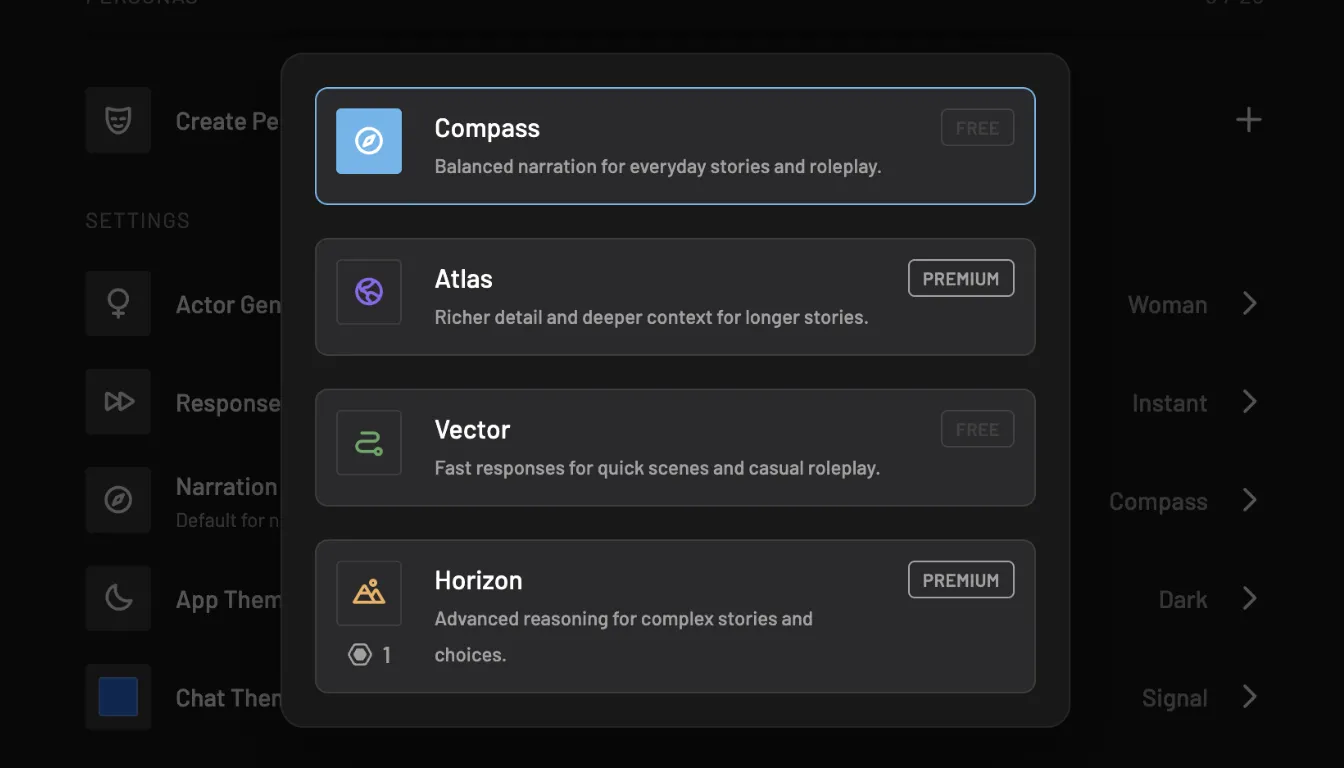
Introducing Myrlo's New Models
Starting with the next update, Myrlo will offer four distinct models, each tailored to address different user and storytelling needs. These models represent a strategic expansion of the platform's capabilities, allowing users to select the most appropriate tool based on their specific requirements. The four models—Compass, Atlas, Vector, and Horizon—each bring unique strengths to the table, with a balance between speed, depth, and reasoning capabilities.
Key Differences
Compass is the closest to the existing Roleplay model, and strikes a balance between speed and depth, with a 20% speed improvement over the older version. Atlas builds on this foundation by providing double the context and memory, making it ideal for tasks requiring more contextual understanding. Vector prioritizes speed at the expense of depth, which can lead to more cliché storytelling in certain scenarios. Finally, Horizon focuses on reasoning and larger context, albeit at the cost of speed, making it suitable for complex narrative tasks that demand deeper analysis.
Enhancing the Player Experience
This new set of models significantly enhances the player experience by offering tailored solutions for diverse needs. Each model addresses specific use cases, allowing users to select the one that best matches their priorities, whether it be speed, depth, or reasoning. This flexibility ensures that users can optimize their workflow and storytelling process without compromising on quality or efficiency.
Choosing the Right Model
Selecting the right model in Myrlo requires a careful consideration of the specific needs and goals of the user or storytelling task. Each model offers unique drawbacks and weaknesses, making it essential to evaluate which attributes are most critical for the intended use case. For instance, if a user is concerned about the story losing its narrative coherence, opting for a stronger model like Horizon might be beneficial. Conversely, if efficiency is the primary concern, especially for free users, Vector provides a faster alternative, albeit with less depth. Ultimately, the choice of model should align with the user's priorities, ensuring that the selected tool effectively supports their creative or analytical objectives.
Users should also consider the nature of their storytelling or analytical tasks. For example, if a story requires extensive contextual understanding and nuanced reasoning, Atlas may be the most suitable choice due to its double context and quantization features. On the other hand, if speed is a priority and depth is less critical, Vector offers a faster alternative that may be more appropriate for certain scenarios.
Discovery


